Blog · Debt & credit · July 30, 2026 · 6 min read
Buy now, pain later: how BNPL rewires your spending
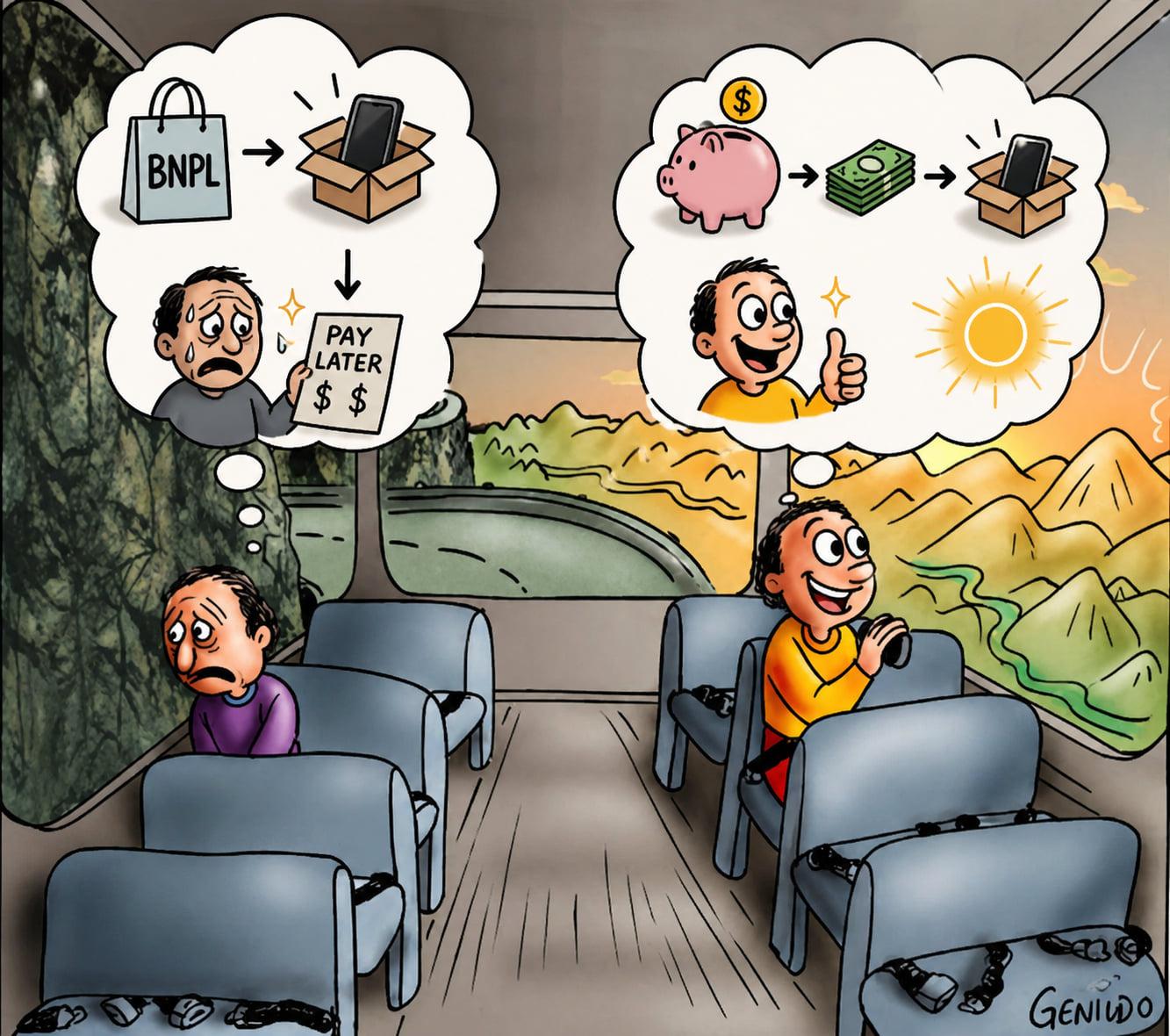
Four payments of $25 doesn’t feel like $100. That’s not a flaw in your brain — it’s the product working exactly as designed.
The trick is in the split
Picture a $100 hoodie at checkout. One button says $100. The other says “4 interest-free payments of $25.” Same hoodie, same money leaving your account — but your brain prices the second button at $25.
Behavioral economists call the feeling you just skipped the pain of paying — the small, useful sting of watching money leave. Cash hurts the most: you physically hand it over. Cards blunt the sting. BNPL is built to remove it twice — it shrinks the number on the button, and it pushes most of the payment into a future you can’t feel yet.
The blunting effect is not small. In a famous MIT experiment, shoppers bidding on the same item were willing to pay dramatically more — in some cases nearly double — when paying by card instead of cash. BNPL pulls the same lever harder: the money is invisible and the price is quartered.
One split purchase is harmless. The problem is that this discount your brain applies happens at every checkout, every day — and it compounds quietly.
From fringe to default checkout
BNPL stopped being niche years ago. The U.S. Consumer Financial Protection Bureau tracked the five biggest providers and found loan volume grew roughly tenfold in two years — from about 17 million loans in 2019 to 180 million in 2021. By 2022, more than one in five Americans with a credit record had used BNPL at least once.
If you live in the Gulf, you don’t need the statistics. Tabby and Tamara sit in the default checkout of nearly every major retailer in the UAE and Saudi Arabia — electronics, fashion, flights, sometimes groceries. The button isn’t framed as financing. It’s framed as the smart way to pay: same price, split in four, no interest.
That framing matters. Nobody thinks of themselves as “taking out four loans this month.” But that is, legally and literally, what happened.
Credit cards walked so BNPL could run
Buying now and paying later isn’t new — credit cards decoupled purchase from payment decades ago, and household card debt has been climbing ever since. But cards still carry built-in speed bumps: a visible limit, a monthly statement that sums everything into one ugly number, and interest everyone has been warned about since childhood.
BNPL strips even those away. There’s usually no interest, so it doesn’t feel like debt. There’s no statement, so there’s no monthly moment of truth. And historically, most BNPL loans weren’t reported to credit bureaus at all — the industry’s own name for this is phantom debt. Invisible to the bank assessing your mortgage application, and — more dangerously — invisible to you.
A credit card at least sends one bill that says $600. Three BNPL apps send twelve friendly reminders of $50 each, and no app anywhere shows you the total.
Stacking: where the spiral starts
Nobody gets in trouble over one hoodie. Trouble is the parallel plans: hoodie + sneakers + flight + concert tickets, each “only $25,” each on its own schedule. CFPB research found that most BNPL borrowers have carried multiple loans at the same time, and recent industry surveys put the share of users who’ve paid at least one installment late at roughly two in five.
Late is where “interest-free” quietly ends: late fees, frozen accounts, and — increasingly — collections and credit-report damage.
The failure here isn’t arithmetic; anyone can add four numbers. It’s that no BNPL provider will ever show you the number that matters: everything you still owe, across all of them, next to what you actually have.
Five rules if you use BNPL anyway
BNPL isn’t evil. An interest-free installment on a planned purchase can be perfectly rational. These rules keep it that way:
- 1. One plan at a time. The next split waits until the current one is finished. Stacking is the spiral.
- 2. Only split what you’d buy at full price. If “4 × $25” closes a deal that “$100” couldn’t, that’s not you deciding — that’s the split deciding.
- 3. Know your slice total. Once a week, add every remaining installment into one number. If you can’t say it out loud, you have too many.
- 4. Autopay, with a buffer. One missed $25 payment can cost more in fees than the interest you avoided.
- 5. Never split consumables. If it’s gone before the last payment — dinner, groceries, a tank of fuel — don’t split it.
The antidote is visibility
Every mechanism in this article hides spending at the moment it happens. That’s why the fix isn’t more discipline — discipline is exactly what the design defeats. The fix is structural: put the number back where the decision happens.
Why visibility works:
- ✓It restores the pain of paying. A running daily total next to the “4 × $25” button makes your brain price it as $100 again. No willpower — the number does the work.
- ✓It kills stacking. Installments from every provider land in one feed with one total — the number no BNPL app will ever show you.
- ✓It redirects the habit. BNPL trains you to live in small recurring payments — the exact skill saving requires, aimed the wrong way.
That last point is the real unlock. BNPL and savings goals are mirror images:
BNPL
Four payments backward, for something you already own. By installment three, only the obligation is left.
Savings goal
The same payments forward, for something you still want. Anticipation instead of obligation.
Dibba is built around this reversal. Every banking SMS and Apple Pay notification is parsed the moment it happens — BNPL installments included — and today’s total sits on your Lock Screen. Goals are broken into the same shape: “save $4,000 by May” becomes a today-sized number, no bigger than the installment it replaces.
Several of our early users arrived with parallel BNPL plans running. Within months of seeing their daily totals, they closed the last installments and pointed the same weekly amounts at goals instead — an emergency fund, a trip, a deposit. Income unchanged. Direction changed.
Impulse spending — and BNPL is impulse spending with a payment plan — dies in daylight.
Ready to save for Your Dream?
Join thousands who are already saving with us — free, in 2 minutes.